Learn
Leadership briefings, hands-on tool training and technical workshops that give everyone a shared, practical view of what AI can do.
AI delivery partner · Sister company of Best Practice AI
We help organisations learn, plan, build and adopt AI, and we stay to make it work. A senior team that runs the workshop, designs the architecture and ships the system.
Most AI programmes stall between the strategy and the build. We stay through every stage, so nothing is lost in the hand-over.
Leadership briefings, hands-on tool training and technical workshops that give everyone a shared, practical view of what AI can do.
Readiness review, use-case priorities, data and systems architecture, and a phased plan with a business case the board can back.
We build, host and support the working system: knowledge engines, computer vision, agents, dashboards and integrations.
Make it stick and keep it safe. Change management for the people side of AI: champions in every team, ongoing coaching, showcases of colleagues' wins, and measured adoption on a scorecard for the board. Proportionate governance alongside: policy, an AI register, risk tiers and human oversight, aligned to the EU AI Act and UK guidance.
Workshops
On site or remote, for leadership or for the engineers who will run the systems. Each one ends with a written set of next steps.
From what AI can do to a ranked list of use cases, an operating playbook and a 30/60/90-day plan.
How AI connects safely to your ERP, CRM and production data, with a hands-on build session.
Data rules, the six-step prompt and how to check what AI tells you.
The risks and harms of AI, the EU, UK and US rules, and a governance framework scaled to risk.
Our work
Brintons · Luxury carpets · Manufacturing
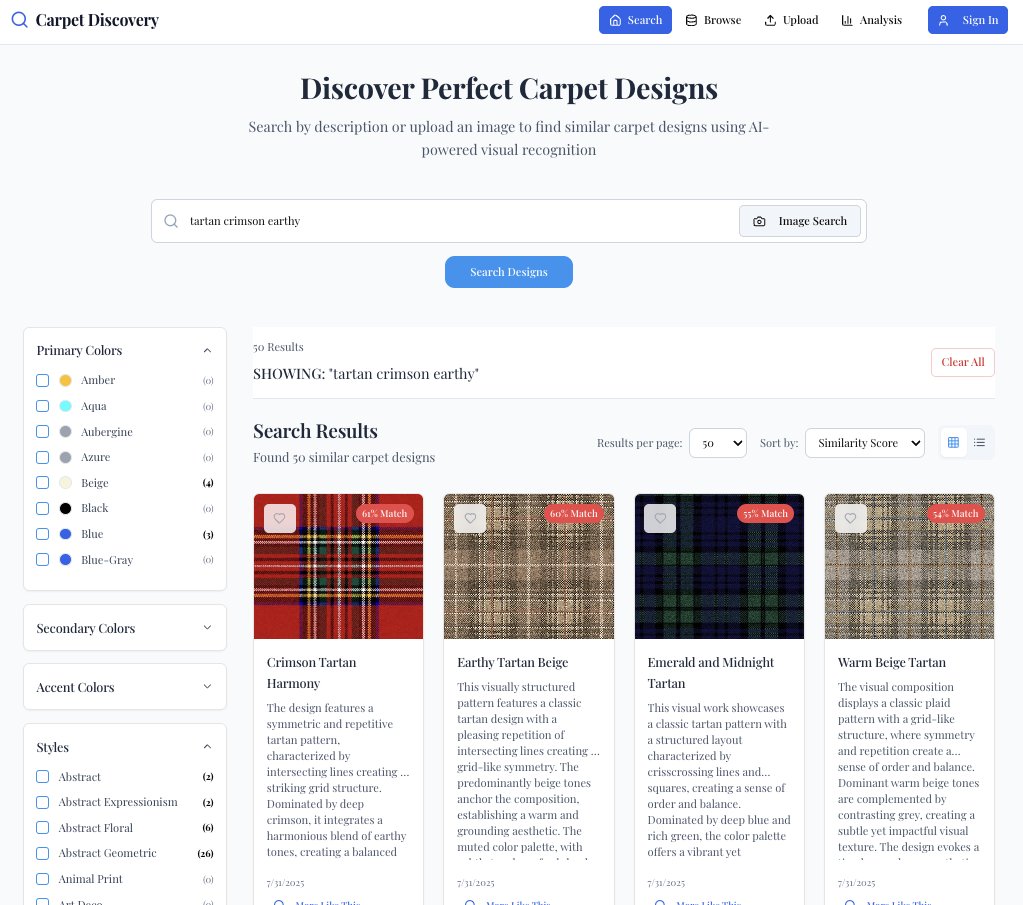
More than 40,000 designs tagged automatically for style, motif, geometry and colour. Designers and clients search by written brief, image or mood board, with results in a fraction of a second. Live in Brintons' Design Studio Online since March 2026 and used daily by design teams in the US and Europe. Built on PatternMatch.ai.
“PatternMatch.ai has transformed how we access and use our design library. It has made our designers and sales teams faster and more effective.”
ORtelligence · Orthopaedic surgery · Healthcare
Operating theatres manage hundreds of trays, instruments and implants, and missing kit delays surgery. We led the technology for a phone app that photographs a tray, recognises every item and flags what is missing, trained on synthetic 3D renders so a new tray could be added in two to three weeks. Patented: US 2022/0292815 A1.

Salus AI · Sales compliance · US healthcare
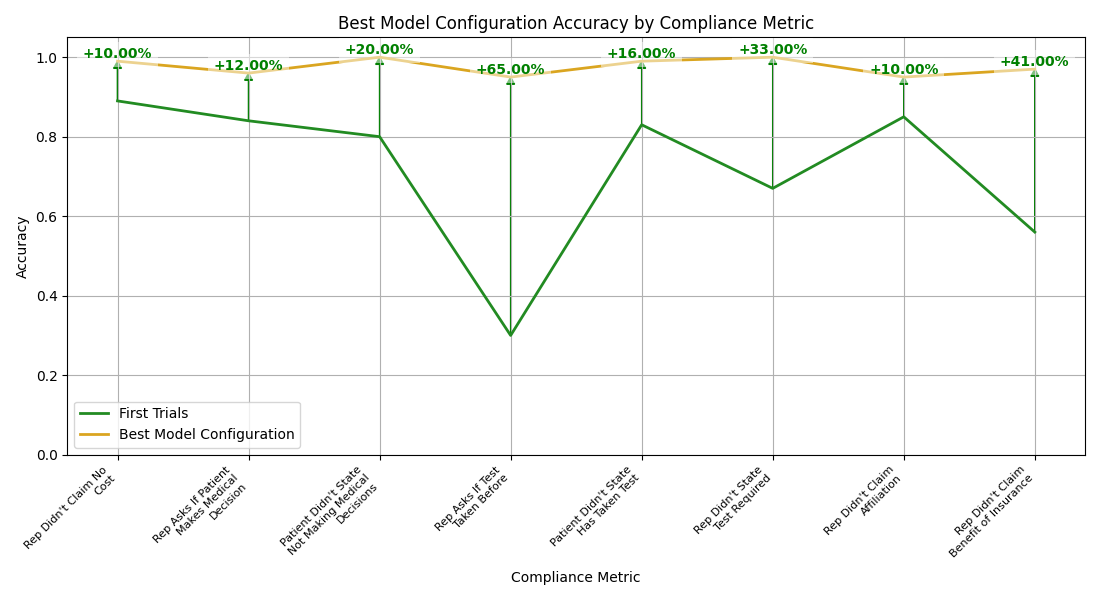
Every outbound sales call transcribed and checked against federal and state rules, with flagged calls routed to compliance staff and reports within 24 hours. We designed the rules engine and moved it to large language models, raising accuracy from about 80% to 95–98% and cutting model cost by up to 80%.
Have a problem like these? We'd like to hear about it.
Discuss your projectIndustries and functions
We have built and governed AI in regulated and operational businesses, and we bring that experience to each engagement.
Design libraries, product knowledge, quoting, production planning and service.
PatternMatch.ai for BrintonsComputer vision for surgical instruments, compliance monitoring, clinical and commercial workflows.
ORtelligence · SalusContent creation and tagging, archives and search, audience insight and rights.
Document review and extraction, research and checking, knowledge management.
Financial-crime and compliance controls, reporting and analysis, customer service, governance aligned with FCA expectations.
“Best Practice AI was a key part of the team on the World Economic Forum's Empowering AI Leadership project.”
“Your Generative AI workshop was excellent, pitched at the right level and practical too. You helped make our Partner conference a great success. We have never seen such engagement from our partners before!”
The playbook
The playbook we use with clients to move AI from pilots into everyday operations: ownership, skills, tools, governance by risk, data foundations, value and cost, with a self-assessment and a 30/60/90-day plan.
Request the playbook
Strategy & workshops
More than 25 years in AI and digital innovation. Co-founder of MapQuest, one of the first internet companies, and partner at Best Practice AI, advising executives on AI strategy, technology and governance. Contributed to the World Economic Forum's Global AI Council toolkits on safe AI adoption, and speaks at Harvard Business School, the BBC and elsewhere. Former Chief Digital Officer leading transformations at HomeAdvisor, Bowers & Wilkins and PE-owned directory businesses. President Emeritus of Harvard Business School Alumni Angels UK. Harvard MBA; first-class BA in Computing & Artificial Intelligence, University of Sussex.

Governance, legal & risk
UK and US lawyer specialising in financial crime, fintech, cyber and AI risk. Former Joint Head of Fraud, Bribery & Corruption at the Serious Fraud Office, enforcement lawyer at the Financial Services Authority, Chief Compliance Officer of Rolls-Royce and regional compliance attorney at Microsoft. Partner at DLA Piper, Fieldfisher and Shepherd and Wedderburn. Chairs the Audit and Risk Committee of the Commonwealth Secretariat. MSc in Software and Systems Security, University of Oxford; JD, Northwestern; BA in Economics, University of Pennsylvania.

Build & delivery
Data scientist and engineer who has built machine-learning and computer-vision systems since 2010, and the architect behind our delivery work, from PatternMatch.ai to the technical architecture workshops. Former Principal Data Scientist at Digica, working on distributed computing, data management and machine learning. MSc in Machine Learning, University College London; PhD in high-quality texture synthesis, University of Warwick; second PhD in computer vision with active learning, Brno University.
Questions we're asked
Real questions from our discovery calls and workshops.
All 94 questions →Start with alignment: a half-day leadership workshop that explains what AI can and can't do and agrees a short, prioritised list of use cases. Then get your existing users trained properly, automate one or two high-value reporting or document tasks, put light governance in place, and deliver quick wins you can show the board. Small, visible steps beat a big programme that takes a year to report back.
Free consumer versions may use your data for training; business and enterprise versions can be set so they don't, with retention and admin controls. Use company accounts on a business plan, check the data settings, and keep highly sensitive information out of any tool that isn't approved for it. We help you choose the plan and settings and explain the security layers in terms your stakeholders can sign off.
It will change jobs, and repetitive desk work will be affected first. But for the next several years the dominant pattern is people working with AI: less re-keying and drudgery, more time for judgement and customers. Experienced people become more valuable, because AI needs someone who knows the business to direct and check it. As we often say, it's not AI that replaces people, it's people using AI who replace those who don't.
It won't be perfect the first time, but it gets better fast. We break the work into small, well-defined tasks, feed the AI only the relevant source material, make it cite where each answer came from, and build review steps into the tool. Early outputs are reviewed closely. As accuracy is proven, reviews lighten, and your feedback is used to improve the instructions.
There are three parts: per-user licences for the AI tools staff use, usage charges ("tokens") for automated work, which grow with volume, and the time of the people who build and maintain your tools. Hosting and connectors are usually modest. People's time is the cost that gets underestimated. Give AI its own budget line and a simple spend dashboard, because it's easy to overspend when you push thousands of documents through a model. Good engineering keeps running costs down, for example by pre-processing documents once rather than re-reading them on every question.
The underlying models are broadly comparable; the difference is in how they are deployed. Copilot is built into Office apps, which is convenient but can feel restrictive. ChatGPT and Claude are more flexible and stronger for building automations and connecting to your systems. Choose on data controls, connectors, automation and what your people will actually use. Most companies settle on one main platform, sometimes two.
Decide case by case against four tests: cost, including your people's time, which is usually the biggest cost; skills (can we build and maintain it?); criticality (if it must be 100% right, like payments, lean towards buying); and speed (building a wrapper around what you have is often much faster). Building also makes sense when no product integrates with your systems or fits how you work, and in-house tools are easier to change later. A common answer is "keep the core system, wrap AI around it, buy where accuracy is critical".
Usually not. Replacing an ERP is slow, expensive and disruptive. The pattern we see working is "keep the core, wrap AI around it". Leave the system, its data and its permission structure exactly as they are, and add read-only views, a secure connector and AI tools on top. People who don't use AI carry on working just as they do today. Many companies are doing exactly this with ageing ERPs.
Tell us where you are on the AI journey and we will suggest the right first step.